Canada: Why ERs are struggling to stay open nationwide
On a Thursday in mid-August, the entryways of a medical clinic's crisis division two hours west of Toronto were closed.
A note posted on the front said the ER was shut for the afternoon. It would return the next morning at 08:00, yet close again for the night. Patients who required dire consideration were approached to go to local medical clinics - a 15-to 35-minute drive away.
It was the 10th time since April that the Huron Public Healthcare Alliance - an organization of four clinics serving around 150,000 individuals in western Ontario - needed to briefly close or cut back hours at one of its crisis divisions.
Furthermore, it won't be the last, said the association's CEO Andrew Williams.
The explanation? There aren't an adequate number of medical attendants to staff the ER.
"You are seeing - practically week by week - clinics lessening their administrations," Mr Williams told the BBC.
It's a situation working out at crisis offices across Canada, especially at more modest medical clinics where decreased administrations have become ordinary.
In the sea territory of Nova Scotia, one emergency clinic's ER has been shut since June 2021 due to staffing deficiencies.
Canada is quite possibly of the most extravagant country on the planet. Its widespread openly supported medical care framework has been promoted by moderate lawmakers in the US, the country's southern neighbor, who see it as a required option in contrast to an American framework where millions stay uninsured.
Yet, as of late, Canada's framework has been portrayed by laborers and emergency clinic leaders as being in a condition of "emergency".
That incorporates battling trauma centers.
Toronto ER doctor Dr Raghu Venugopal said he has seen cots covering the foyers, involved by patients experiencing sicknesses like a messed up hip or stomach torments.
On certain days, those patients might stand by somewhere in the range of two to four days to be owned up to emergency clinic, all while a group of two medical caretakers keeps an eye on a sum of 50 to 60 patients on the unit.
Different patients are being analyzed in the lounge area in light of the fact that the absence of staff has constrained pieces of the ER to close, importance there is restricted space so that specialists could see them secretly.
"We are in a standard-less void where anything goes, and it is stunning," Dr Venugopal said.
In the grassland region of Saskatchewan, one medical caretaker said a few paramedics have spent the sum of their 12-hour shift holding up with a patient on a cot as nobody was around to concede them for therapy, leaving the paramedic inaccessible to answer different calls.
Patient stories have likewise arisen the nation over.
In Ontario, a lady told the CBC she spent a sum of 19 hours in ER with serious backpain before she was conceded. She was subsequently determined to have malignant growth. In New Brunswick in July, a man kicked the bucket while hanging tight for care, and the emergency clinic has sent off a survey.
The difficulties welcomed on by Covid-19 bear part of the fault.
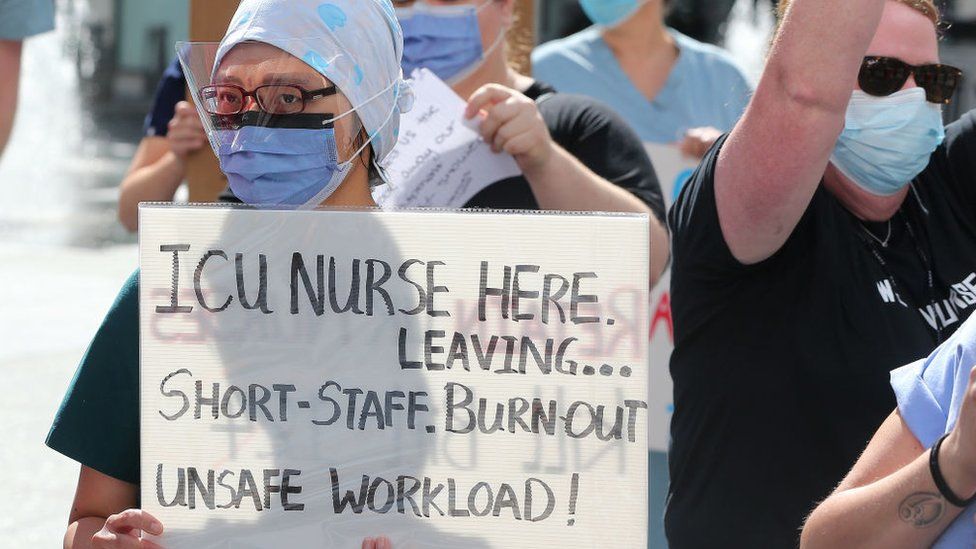
Many medical caretakers in Canada - exhausted from the pandemic - have said they intend to pass on the calling due to burnout and restricted help. Comparative opinions have been communicated by medical caretakers in the US and in the UK, where a strike vote over compensation is approaching.
In any case, specialists express many years of terrible arrangement, including the conclusion of medical clinics and past grimness spending plans, combined with Canada's huge and complex topography, have exacerbated the pandemic strain.
This has lighted a public discussion on the most proficient method to hold staff - essentially nurture - and how to save a treasured general wellbeing framework that is confronting mounting strain as it attempts to really focus on a maturing populace.
Many are inquiring "what sort of framework do we need", said Jennifer Jackson, an associate teacher at the University of Calgary's staff of nursing, "And assuming that we need that framework, what is expected of us as a general public to arrive?"
Outline showing number of medical clinic beds per 1,000 individuals from 11 most extravagant nations on the planet.
The cutting edge rendition of Canada's general medical services framework - under the Canada Health Act - has existed starting around 1984, however its foundations were laid many years sooner in the territory of Saskatchewan. England's National Health Service, laid out in 1948, filled in as motivation.
Canada's framework, be that as it may, positions lower by and large than the UK and others in global examinations.
A 2021 report by the Commonwealth Fund recorded it as second-last in general among a rundown of 11 rich nations - above just the US. There are 2.5 clinic beds in Canada per 1,000 individuals, setting it close to the lower part of OECD nations.
Canada explicitly slacks with regards to fair access and care results.
Information throughout recent years shows individuals are standing by longer in the ER before they are either seen by a specialist or owned up to clinic. Almost 5,000,000 Canadians don't have a family specialist, frequently making a trauma center their essential spot to find support in the event that they need it.
Throughout the long term, as Canada's populace filled in size and age, its medical services limit battled to keep up. Rustic clinics - where it tends to be a test to enlist staff - have been generally impacted.
This is exacerbated by a vacuum of nursing ability that existed before the pandemic. There were 34,315 empty nursing position in Canada toward the finish of 2021 - a 133% expansion from 2019.
It is assessed that Canada will be short 117,600 medical caretakers by 2030. 33% of the ongoing labor force is near retirement, and in a 2021 public study, almost 60% of early-vocation medical caretakers say they are thinking about leaving their present place of employment.
While there are no authority numbers on the number of attendants that left the calling during the pandemic, sources the BBC talked with for this story discussed medical caretakers that have scaled back their hours or taken exits from any 9 to 5 work.
Those that remain say they feel the strain. Saskatchewan ER nurture Jacelyn Wingerter, 22, started working only eight months prior however as of now feels wore out.
The lounge area of the ER she works in can hold 20 patients, yet has seen up to 50 as of late in the midst of an ongoing lack of medical caretakers.
"Our pattern should be 19 [nurses], however that never occurs", she said. "We are in every case short."
In May, she worked a sum of 290 hours to fill the hole, around 70 hours every week.
The weaknesses of the framework are most noticeable in the ER since it's generally expected the catch-for all wellbeing crises, said Ms Jackson.
Shutting the ER is never a simple choice, said Huron Public Healthcare Alliance's Mr Williams, however one his clinics have needed to make as an ineffectively staffed ER can be perilous.
"Our commitment all the time is to give the most secure consideration that we would be able," he said.
In any case, there are ramifications. Brenda Gascho, a medical caretaker at one of the emergency clinics Mr Williams regulates, said a conclusion at one ER implies a greater excess at another close by.
A few patients wind up leaving without being seen by a specialist or a medical caretaker, disturbed by lengthier-than-normal stand by times, she said.
Individuals previous consideration as a result of the framework's inadequacies is something Ms Jackson stresses over. Medical caretakers and specialists in Canada are still the absolute generally profoundly prepared on the planet not entirely set in stone to do their best anything the assets, she said.
A few answers for the emergency proposed by those in the area incorporate expanding compensation for existing medical caretakers, permitting globally taught medical caretakers to rehearse in Canada, and expanding the limit of nursing schools the nation over, particularly in provincial regions.
Others have called for subsidizing to be expanded for care situated locally, so that individuals can get to help before they end up in the ER.
Territories are answerable for the medical care framework in their separate purviews, however they depend on subsidizing from the national government.
Head of the state Justin Trudeau has said that Canada's general medical services framework "is perhaps of the best thing" about the nation, and that his administration is focused on working with regions to "guarantee Canadians get great, quality" care.
Ms Jackson said the test of medical care strategy is that chiefs will generally zero in on momentary arrangements, however medical services in Canada could likewise profit from bigger redesigns that can build admittance to everybody in the long haul.
The significant choices made today, she said, will significantly affect people in the future.
Comments
Post a Comment